Showing posts with label Overthinking. Show all posts

Wednesday, April 9, 2025

Overthinking: When Your House Falls on a Witch


I live in Oklahoma. It is the state due south of Kansas and a fellow sufferer of Tornado Season. Like most people in the Midwest, I have several childhood traumas involving thunder storms, rumbling sheet metals roofs, and praying that my family's trailer house didn't get tossed across the meadow.

Currently, I live in a lovely brick house with large interior wall closets. It has done wonders for my anxiety. I now spend milder storms chatting with my reader friends on Discord.

Naturally, most of them are familiar with the Wizard of Oz. Most of my generation has seen the movie even if they haven't read the novels. During the last storm, someone made the comment “Don't squash any witches.”

My response, “If that happened, I am not looting the corpse in front of that witch's older and nastier big sister.”

That led to a very long ramble about funeral practices and related ehtics, and later this blog.

Illustraion by W.W. Denslow

A little context into my family tree is needed. I was raised by a geologist and a journalist. However, my parents are not the most interesting career combinations. There's a branch on my paternal side that has worked, run, and owned funeral parlors out in California. Great Uncle Ray and his son David demystified a lot of the icky around the subject.

Needless to say, I grew up with an odd understanding of “what happened after someone dies.” While I didn't have any insights on the metaphysical issues and worries, I knew what people on this side of existence had to handle.

A funeral director has an odd professional function. It's been this way since the Egyptians started mummifying the dead. In the U.S.A., they act socially as an event coordinator for the bereaved. This is a position of great emotional and ethical responsibility. Their job is to give the community a safe and orderly way to grieve the loss.

The other element, the icky one, is safe and orderly cadaver disposal. It's not just about hiding away reminders of our morality. Sources of decay quickly become dangerous to the living.

Most of Ray and David's stories were not about clients, living or deceased, but about people 'backstage.' You get all types in the business, and learning experiences range from awkward to ridiculous chains of events. (For example, if a living person lays down in a coffin, that coffin can't be legally resold for burial. A prankster quickly found himself with a very expensive price tag after a failed jump-scare.) I learned a lot by proxy.

Illustration by W.W. Denslow

Circling back around to Oz, I'm not Dorothy Gale. She is a child who lost her parents at an early age and grew up on a farm during the Great Depression. We have extremely different sensibilities and life experiences.

After accidental manslaughter, Dorothy quickly hones in on her goals, getting back to Kansas. She sets out on the Yellow Brick Road to the cheers of the Munchkins and the gifts from the Good Witch (named Glinda in the movie).

I, on the other hand, would not be going anywhere without addressing the issue of the dead body.

Picture this:

The Munchkins are celebrating liberation. The dictator is dead. People are singing and dancing in the street.

Meanwhile the Good Witch watches a shaken Okie piecing together bio-hazard protection. Horrible person or not, the deceased can't stay under my house. I'm having flash-backs to the time Dad had to dig out a burrow under the trailer house because a critter died in there.

Things become yet more complicated when the witch turns to dust. In the movie, this is the scene where the striped socks roll back up under the house, leaving behind the Ruby Slippers. In the book, the Good Witch literally shakes witch dust out of the Sliver Slippers before handing them to Dorothy.

This handily solves the issue of decay. However, my inherited sensibilities will not settled for leaving the rest of the deceased's clothes under my house. The dust itself would be handled with the same care as human ash. I'm going to need a large jar with a lid, and my painter's mask.

By this point, the Good Witch of the North should have serious concerns about my sanity and about handing magic slippers of any color to me. However, magic and fairylands have rules about this type of thing. To the victor go the spoils.

I also have concerns about those slippers. By my reckoning, Glinda has no business giving them to me. This feels scummy. And no, not because she's asking me to wear shoes that someone died in.

You see, funeral parlors and shoes have a long a sordid history. In the old days when shoes were leather and expensive, more than a few undertakers would remove the shoes after the viewing but before the internment. While up-cycling is good, this was often done without the permission of the people paying for the funeral. The shoes and other valuable items would be sold on the side and the undertaker quietly pockets the money. Grave-robbery before the grave is even filled.

This is disrespectful and dishonest on multiple levels. Modern societies have complex laws about it, and grave clothes are not 'up for grabs.'

So, I ask if the deceased had any surviving next-of-kin.

Now, in the slower paced book, the two Wicked Witches hated and avoided each other. However, in the movie, this is the point where the Wicked Witch of the West, shows up.

Margaret Hamilton in The Wizard of Oz 1939

“Who killed my sister?! Who killed the Witch of the East?!”

Margaret Hamilton's performance terrified me as a small child. Now however, I'm a 5-foot 5-inch woman who has a younger sister who has nearly died in a car accident. I can recognize anger masking grief.

So, I have a jar of remains, a pile of neatly folded clothes, and magical shoes. Logically, all those items belong to the living witch. If Glinda magics the slippers onto my feet, I'm not going to be happy. That's receiving stolen goods. No thanks.

Luckily for Oz, I really dislike being screamed at or threatened. I would like to think myself mature enough to deescalate even when faced with a ranting witch. However, there is a reason I did not enter the family business. The minute she snarks 'I can cause accidents too' the sympathy bouquet goes away and the pepper-spray comes out.

Ironically, despite all my life experience and 'adult sensibilities' I don't see myself changing the story too much. Like Dorothy, I would want to get back home to my family. Like Dorothy, I have issues with setting out to destroy another witch, this time on purpose, but I would still try.

No, the main difference between me and Dorothy is that when faced with a brown, shapeless mess of melted witch goo, I would be looking for another jar. Dorothy literally throws more water on the remains and sweeps them out the door.
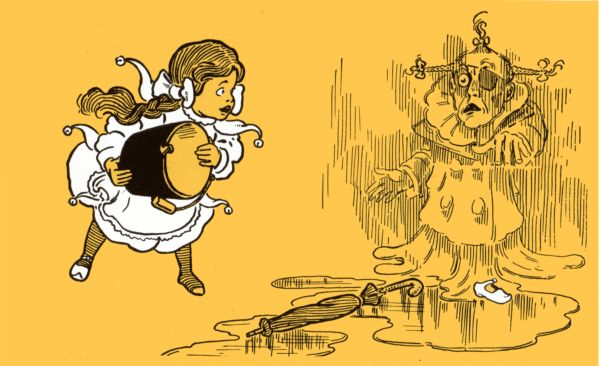
Illustration by W.W. Denslow


Thursday, February 27, 2025

Overthinking: Creating 'Good' Fictional Characters


Compelling stories need compelling characters. As I've reworked, and re-titled, my novella The Odd-Job Wizard, I've discovered that this description is oddly deceptive. What makes a compelling character? Why is it so hard to pull off?

Starting writers focus on uniqueness, making sure the character's back story and physical description them stand out as much as possible. Hair color, physical traits, childhood events, mannerisms, and motives.

The narrative events show off these traits in some dramatic moment. The quipy retort to the antagonist. A display of physical power or moral character. The writer wants their precious brainchild to stand out in your mind, to be vibrant and memorable.

However, a unique character is not necessarily a compelling one.

Take the supernatural romance genre and the vampire lover character.

Edward Cullen from Twilight is unique, to the point that people have turned him into a bit of a joke. He's a vampire, who glitters in the sunlight. His big reveal in the clearing as been parodied so many ways. Edward's sparkles could have been replaced with any traits - glowing in the dark, turning into living stone, carefully hidden wings – yet functionally his role in the story is unchanged.

People don't read Twilight for him. They read it for Belle, the girl-next-door who stumbles into the mysterious and dangerous world of romance.

If unique details isn't the answer, many writers settle into the more 'meta' elements of character design. Archetypes and meta-tropes. These are all ways that the character acts within the narrative and how those interplay with the audiences expectations of stories.

The girl-next-door is unremarkable in a crowd, yet lives a complex life.

The rebel princess will not permit an other injustice, no matter life's pressure.

The wanderer grows with each adventure until they reach the story's end as an inspiring hero or a monstrous warning.

People often select narratives based on their preferred archetypes. Using these meta elements to signal to potential audiences is an intermediate storytelling skills. It's like like running. It's something that comes naturally to all of us, but gets better when it's a trained skill.

However, just using a compelling archetype doesn't guarantee a compelling character.

Consider the fairytale Cinderella. At its core, the story is that people who stay kind in spite of tragedy and abuse are beautiful and get recognized for that. I greatly enjoy that type of narrative. However, when ever a new 'Cinderella' story comes out my first instinct is 'Oh, not again.' Half the time, the protagonist makes me want to reach through the pages of the book and shake some sense into them.

Audiences can and will reject a character, even a unique take on a favored archetype. 'they're flat' 'they don't make sense' 'I just don't get them.' Audiences want to connect with characters emotionally. The missing ingredient is empathy.

Compelling characters are understandable and the audience empathizes with them. This is not to say they relate to the characters on a personal level and are rooting for them.

Game of Thrones by George Martin is popular because he is very good at drawing the readers emotions into the stories. Despite the series violence and constant killing off of audience favorites, people keep coming back to watch the characters. Their struggles and moral choices resonate, even if it's just to digust and outrage. (I personally have many issues with his works. However, I freely admit that Martin is a master at his craft.) Thoughts like 'he didn't deserve that', 'she got what was coming to her,' and such are all signs that the audience is empathizing with the characters.

For the audience to empathize, to have an emotional response, the storyteller has to make the character understandable. This is not the same as making the character have 'common experience' with the audience.

For example, nobody living has 'stood in ulfish thought beneath a tumtum tree.' Most of us have never touched a sword, much less made a vorpal one go snicker-snatck. On a factual level, we have little in common with the unnamed hero of The Jabberwocky.

However, what we do have in common is the act of having to face whatever horrible thing is haunting our lives. Of deciding 'enough is enough.' You beat the monster and go home to a brighter world. This is a universal experience. The whole poem builds to this moment by pulling at your sense of uncertainty, caution, and second guessing. You celebrate with the narrator 'Frabjous Day! Callooh-Callay.'

One of my biggest fears as I send queries is that Leon, the handyman wizard, isn't a compelling protagonist. I have finished with round of editing, and believe a nice blend of uniqueness and a stable core concept. What I worry about my ability to make readers 'care' about what he does and feels. Like we seen in the Jabberwocky poem, this comes down to your skill with language and pacing.

I've been designing and refining Leon for a few decades. In my head he is a rich, full character. However, the only way to know if he is compelling is to send him out, to face the real chance of rejection, criticism, and mockery.


As I pluck up the courage to send querie letters to agents,

Wednesday, January 29, 2025

My Second Draft and Internet Search History


As an chronic overthinker turned writer, I walk a delicate balance between attention to detail and spending too much time nit-picking things that the readers won't care about.

My brain is such, I need a degree of confidence to add anything into the narrative. This has led to long researchers sessions for my WIP (possible title changed to “The Odd-Job Wizard”). As I wrap up the second draft, my internet serach history had gotten very werid. Here are some of the highlights and an explaination for them.


Historical Building Design

The most notable example in the story are three 'sets' the water channel for the mill, assessors offices, smokehouses. Swindlers Bounty is a frontier colony. I needed a technology level that fit. Also, I had to see if it was possible for the characters to up-cycle the building. Leon's smokehouse was based of one from a Ante-Bellum plantation. They could cure multiple carcasses as once.

An invaluable resource were the illustrated 'If you lived in a __' books that were popular with Usborne and Scholastic in the 90's. The cutaways made it easier to get a sense of scale for the character. This helped with the water mill scenes. It also gave me the technical name for breakable-yet-could-be plausibly-repaired pieces.


How Big Is It?

Animals also required a bit of legwork. Mostly to check size and weight. My problem once again was getting a sense of scale. I ended up writing down numbers and pacing out the size with a tape measure.

The first draft had Celabramar's politically fraught snacks being cows and the ranchers more like old Western beef barons. This was changed to sheep as they were smaller and easier for a dragon of his size to lift off the ground.

I also fact checked the size of a moose head trophy through a taxidermist website. They are big, but surprisingly light. (Makes sense in hindsight.)


Unit Conversion and Geometry

The biggest time sink was converting units of measurement. I cracked open the old geometry book to figure out the size of Celabramar's horde. I used the length of the dragon as the diameter of a cylinder and figure out the average height of the treasure pile.

From there I made a guesstimate of the value, by creating three equations for treasure piles made of mostly gold coins, mostly silver coins, and most copper coins. For fun, I also looked up the market value of beef cows and calculated how many cows each would buy.

All this work was to figure out how much Celabramar was willing to spend on moving his lair. It also lead to the plot device of his horde having more value as an coin collection than raw metal.

There were also other equations. However, they were before I settled on the idea of hot air balloon travel.


Red Meat or White Meat?

One of the last, and perhaps silliest, bits of research was about meat.

Throughout the story, Celabramar hunts several different prey animals for trade or food. I felt confident writing about deer, goat, sheep, crab – I've eaten them. The two I have not are rabbit, which is expensive if you don't raise or hunt it yourself, and swan.
Swan used to be a commercial meat. However, the bird was granted protected status in the U.S.A. Unlike with rabbit, I had trouble finding repeatable and ethically sources descriptions swan meat.

In my first draft, Celabramar declares that swan is “Good red meat, lots of fats for the brain.”

My editor Meg Dendler was very confused by this. She replaced the the line as white and lean, more in line with a traditional poultry. I can safely say she had never eaten swan either.

However, I have eaten duck. Duck is dark meat, darker than turkey. It's also lean muscle fiber but the skin has a protective layer of fat that keeps it moist when cooked. I assumed, correctly, that swan was as to duck as turkey is to chicken – bigger with darker meat. My researched backed it up.

Nevertheless, the goal of a editor is to help the story make sense to readers. Duck is not a common dish in the U.S.A. However, turkey is a holiday tradition. With this common ground, I reworked the description to

“Nice dark meat, good bit of fat too. Excellent for the brain.”

This one line took about an hour of fact checking and world building. There are more detailed descriptions of swan like 'rich,' 'moist,' 'gamey,' 'fishy mutton,' etc. However, it's mostly for cooked swan and varies by dish. The dragon is describing raw, uncooked swan. He'd cares more about its nutritious value than its optimal wine pairing.


This is why it takes me so long to write anything! My brain overthinks everything.


Wednesday, December 11, 2024

Overthinking: Dragons, Fingers, and Math


When most people world build fantasy tales, they try to follow in the footsteps of Tolkien, Le Guin, and other great world-builders. They invent landmasses, history, languages, and art.

Meanwhile, there's me. My dragons have math.

All math starts with a counting system. In the real world, this comes from by counting fingers on the hand. We have sets of five, ten, and twenty (for when you add toes). From there you develop digit symbols - 1, 2, 3, 4, 5, 6, 7, 8, 9, and 0. Through out history, humans have favored ten-digit systems. It appeals on an instinctual level.


In a fantasy story, people use assume that everyone uses the same math. Typically, it's not something that matters in a plot. Nevertheless, I overthink everything.

An elf or even a centaur has the same hand as a human does. They likely use a similar system with different symbols. Meanwhile, dragons are decided not human or human adjacent.
To complicate things, there are multiple types of dragons in Mundus. One of my draft notebooks has a scribble that dragon in Mundus treat gravity and other natural laws as 'suggestions.' Celabramar is a a massive quadruped with wings. Madam Vircroc is biped like a velociraptor with vestigial wings. At the end of the story, yet another dragon uses the knuckles of their wings and short hind legs to walk like a bat.

All this biodiversity means that there isn't a standard set of twenty digits on a dragon. A dragon with wings and two back legs would only have digits on their feet. That number of digits could also vary from dragon to dragon.

If the feet are built like a bird's for grabbed and perching, there would be three forward and one pointing back. (There could also be just three or just two.) If they are more like a dinosaurs, say a sauropode, there will be five. Some dragons don't even have feet. The dragons of Mundus need a counting system that works for them, not for humans.


My solution was to have them use a base-five system. Four-toed dragons count your claws – 1,2,3,4. Most other dragons will count the longest four fangs. If you have more than four toes, the short extra acts like the zero when you write ten '10.' Short fangs also fill this round. Two long and one short means one group of four plus two, our six. (Base-five, the quinary number system, is a real thing. It used in Astralian First Nation languages like Gumatj.)

The biggest difference is that dragons won't name all the numbers that humans name in a ten digit counting system. For example in English, we have unique names for the first twenty numbers and then name the groups of ten up to hundred – thirty, forty and so on.

My dragons name their numbers up to sixteen and then name groups of eight digits. Numbers five through nine don't have special digit symbols just like our eleven is written as '11.'


So what does this mean from a storytelling angle? Well, in Mundus, it means that some people foolishly think that dragons are stupid because they 'don't know what twenty it.' However, it's really a translation error. Dragons have math, advanced math even. It's a necessity when you are a nation of large carnivores managing wild food sources. Averages, perimeters, rate of change, and probabilities- these aren't just things in a textbook for dragons. Dragons are scary good at math.

In my W.I.P., Celabramar converts volume from square feet to bushels without a reference table or calculator. He also converts pounds of silver to the market price of sheep. He also reads and corrects Leon's math, which was written in human numbers. Celabramar lives in a cave, can't hold a pencil, and can do algebra in his head. 

Leon is a Wizard. He's basically the guy who went to college and finished a Master's Degree. That doesn't stop him from making mistakes because he is tired or focusing on the wrong things. 

I did this on purpose. It's been in my notes for years. I wanted the reminder that technology and culture isn't a sure indicator of education and intellegent. If you judge only the surface level, you miss so much of the world. 

On a lighter not, the story has yet another dragon math Easter-egg. Through out the story, Celabramar uses several techniques to mange his temper – deep breaths, shredding a tree, and self-talk. Celabramar stops himself from yelling at a bigot by counting in his head.

He counts to eight, not ten.

Wednesday, October 23, 2024

Overthinking: Crickets, Cotton, and Colonialsim

Bugs are not part of the modern Southern diet. Most of the locals go happily through their days without considering eating them.

Most locals don't have a stupidly sensitive stomach and a restricted diet. My protein sources are limited to animal products and less than half of the commercial available seeds and nuts. I have next to no 'shelf-stable' proteins.

I've been strongly considering eating bugs, cricket specifically.


Unfortunately for me (and fortunately for my family who shares the kitchen) crickets will not be added to my menu any time soon. The only crickets for sale were novelty snacks on Amazon. Everything else would require international shipping.

This didn't make sense to me. Less than ten years ago crickets and 'cricket flour' rose in popularity as a superfood and a less environmentally damaging protein. What had happened to the crickets?


I dug a little more and found part of the answer on a U.K. supplier's site. “No Arsenic” they boasted. Apparently, there had been a big recall of cricket flour after a quality tester found multiple brands containment with arsenic. The bad PR pretty much killed the cricket's popularity.


A normal person would have given up at this point. “Too expensive. Too risky.”

I, however, reverted to my environmental science brain. “How the heck did that happen? Arsenic is not naturally occurring in crickets. It can't be like cherry pits and cyanide?”

Obviously, the crickets had eaten the arsenic at some point in their lives. How had they gotten access to it?


This answer was easier to find than edible cricket. The farmers had accidentally fed arsenic to the crickets with their food supply, cheap rice. The rice had arsenic.

Finally, all the pieces fell into place. The U.S.A has long had a problem with arsenic contamination in the soil.

Ironically, we can blame the Southern cotton industry. Arsenic was historically used to protect the plants from...bugs. The toxin then leeches into the fields and water supply. As the fields were repurposed, the new plants uptake the arsenic.
Rice is a thirsty plant and can easily become too tainted for human consumption. (Despite producing over 20 billion pounds of it per year. The U.S.A. still must import food grade rice.)

So, the cricket farmers must have bought the cheaper, local, low quality rice to feed their stock. However, unlike traditional livestock, the crickets can't be butchered. The arsenic stayed in the insect bodies even after roasting and milling.


“Yet another victim of colonization and industrialization,” I sighed to myself and began scrolling through examples of cricket cuisines in other countries. Little did I know my hunch was dead right.


“They eat all the snakes, and lizards, and spiders, and worms, that they find upon the ground;
so that, to my fancy, their bestiality is greater than that of any beast upon the face of the earth,” Diego Álvarez Chanca

This wonderfully dehumanizing quote is from a companion of Christopher Columbus, (im)famous European explorer who launched the colonization of the American continents.

Colonialsim depends on viewing the indigenous populations as primative, stupid or any number of justifications to treat them as lesser beings. In the European mind, insect diets were yet another excuse to justify supplanting the locals.

As the Europeans brought their own culture and values, native populations became shamed out of eating bugs. The few who weren't shamed would find the once bountiful food source dying off as insecticides and invasive species were introduced.

Land became converted to cash crop production. The goal wasn't local biodiversity. It was how much cash crop you could produce. Even animal protein followed this trend: cattle, swine, and sheep. Why bother with bugs?


Colonialism is the stage for many injustices, slavery, racism, genocide. In comparison, a white gal with a tender stomach not being able to buy crickets seems not worth mentioning.
However, that's the thing about toxins, there is not a single generation of victims. The consequences of poisoning the land and ideologies are long lasting. It impoverishes the future – whether through limited dietary options, families living near pollution become trapped in poverty due to compromised health, or using food to mock and belittle people.


In a better world, I could eat crickets.


Wednesday, October 9, 2024

Overthinking: I'm a Writer?


In August 2024 , I finished the second draft of Don't Fireball the Neighbors (Title Pending). My next challenge was to figure out how to turn my manuscript into a published novel.
One of the first things I did was met with Janice Buswell, a local novelist. I bribed her with lunch at a Thai resturance to pick her brain. It was a productive meeting.

I didn't walk away with ten step plan to grow a platform or a agency contact. What I got was advise on finding an editor and restructuring my time management. Basically, it was time to stop treating writing as a hobby and take it to the next step.

“Introduce yourself as a writer,” She told me “When you walked over, you mentioned your petsitting business.”

She continued to explain that introducing myself as a writer directs the conversation to my work and writer's platform. It's good advise from a self-promotion stand point. (It's the many reason I use “House and PetSitter” in my intro's. I find new clients and good booking that way.)

As with all good advise, it's easier said than done. Can I call myself a writer?


A large part of my mental block to claiming "Yes, I'm a writer" is that is was never my career focus. In college, I tended to the other half of the brain - WatchMaking and MircoTech and then later Environmental Engineering. 

I also lack the hallmarks of 'serious writers.' My membership in writer's groups has been patchy due to distance and my various side-jobs. 

More damning, I've never published anything. I wrote essays for my humanities electives, made modifications to some Dungeons and Dragons games I hosted, but never submitted anything since a church poetry contest in my late teen.

Writing fiction has never been a professional focus in my life. Why call myself a writer?

After stewing the question over, I used my old stand-by for decisions – A “Why?” and “Why Not?” list

Surprisingly, the Why List was longer and had heavier point values.


The first thing that jump off the page was a counter to my lack of literature background. I've been working on the Lands of Mundus for 2/3rd of my life, since I was thirteen. I've been writing, rewriting, and looking for feedback constantly. I'm not just throwing words into chat-bot. I practice and try to strengthen my skills.

A hobbyist writer is still a writer.

In a similar vein, I am a storyteller. The written word is my strongest method of telling stories. Spend 2/3rd of your life practicing something and you will improve, even if the practice was not the most efficient or structured.

My storytelling skills are specialized around writing.

Finally, I selfishly want to be remembered as a writer. Good books enrich people's lives. I want to create something that does that. (Pet-sitting is service, and a valued one. However, after the first two or so bookings, my clients' honeymoon phase is over. I'm enriching their lives the same way a house-keeper or yard service might.)


Weighing all the pro and cons, I realized the many thing stopping me was overly specific standards for 'what a real writer is,' a habit of undervaluing my own efforts, and the social phobia of having to listen to the follow up question “but does it pay?”

I have nothing to lose but false modesty by introducing my as a writer (my social status is non-existent as a disable adult co-habituating with family). What I gain is the chance to talk about my passion – writing stories.

Calling myself a writer is a truthful description. It's not like I'm claiming to be 'future best selling author' or “Newbery Award Winner.”  I write stories. 


Wednesday, September 25, 2024

Do Mermaids use Wheelchairs?

My least favorite classic fairytale is "The Little Mermaid." I hated the original ending and felt the mermaid had a stupid death. The Disney animated film gave me nightmares.

Despite that, merfolk provide endless fuel for my overthinking imagination. Why make a deal with a sea witch when human have options for getting around without legs?

The Ipswich Mermaid, George Courage, Acrylic on canvas 8"x10".

The idea of merfolk using a wheelchair is not original to just me. In “Roverandom” by J. R.R. Tolkien there is an underseas adventure that ends in a wizard and his merfolk wife getting banished to the surface. The wife becomes a small business owner and very famous swim instructor. She is described to go around in a horse drawn 'bath-chair.'

As charming as that character concept is, I am not Tolkien. He made a living as an English college professor and ploy-linguist. I have an incomplete environmental engineering degree and chronic health issues. My creative approach takes another angle.

Overthinking

When I imagine merfolk in wheelchairs, my first instinct is “I hope wherever they are going is ADA compliant.” While I don't yet need mobility aids, my dodgy joints and low blood pressure make like accessibility toilets, ramps, handrails and rest benches a boon. Unfortunately, many space designers forget or outright sacrifice those features. Smaller bathrooms means more floor space for making money. Ramps and comfortable benches are never seen as 'bold artistic expression.' You can have the best wheelchair in the world, and there are still places you can't go.

If a merfolk uses mobility aids on land, they have to deal with all the accessibility issues that we humans face.

Another thing that comes to my mind with any mobility aid – chair, cane, brace – is long term comfort. I have friends and family who have used all of them at one point or another. Each comes with a unique set of challenges. Chair and braces can cause bruising and circulation issues from long use. Double crutches require training so your wrists and shoulder can take the pressure. Even a walker or a cane requires a degrees of mindfulness.

This is all assuming you're a human whose used to living on land and in the air. Merfolk live in the water. The buoyancy and resistance change is going to be as tricky learning to swim is for us.

Merfolk also have the complication of having *just* a tail. Human do have tails (the tiny bones at the base of our spine). However, we sit on our hip bones. Aquatic mammals like whales, dolphins, and manatee, lack hipbones and the pelvic bone is all but identical to the surrounding spinal vertebral. If a merfolk where to 'sit' upright like a human, all that weight and pressure goes onto a handful of vertebral. (This doesn't begin to touch on if the mer using a lateral tail flick like a shark. That spine isn't going to bend into a chair posture.)

Merfolk would not be able to use a standard mobility aid comfortably. It would take training and modifications.

The last element to consider is cost. Good mobility aids are expensive (especial in the U.S. where making a deal with a sea witch is a less daunting process than dealing with healthcare industry, insurance companies, and out-of-pocket costs.) Even if you use magic to 'cheat,' land mobility aids are going to be more of a tool than a toy. You aren't going to spend all that money and time training unless you are serious about making it part of your life.


All these elements will shape what kind of merfolk can afford or want to spend time on land. Yes, transformation magic is always an option, but that means giving up the sea. Most people are not bubble-brained princesses willing to give up their family, culture, and body over a man they met for a few hours.

One of the core guidelines when I put fantasy beings in my stories is that people are people no matter their shape. People are curious, people are creative, and most of all people find ways to overcome obstacles. Humans want to explore the sky and sea, because it's there. Merfolk want to see what's on the land. Finding other people and sharing ideas is part of how we grow. The land and sea would not be separate worlds. People learn from and inspire each other.


In Mundus

I imagine that merfolk communities do business with the 'terrestrial' neighbors. It's common to see a floating fish market or pods of off duty pilots and divers by a riverbank or city docks. These mers do leave the water for short periods of time, business meetings, trying a meal at a local pub, rolling over to the next stand for a bit of hot gossip. However, tourist merfolk are rare.

Merfolk curious enough to travel on land sort are more akin to people going on a long vacation with curated experience packages. They travel up a water channel and make group trips to see famous on-land sights. The most luxurious trips use magical aids like levitation rings or transformation potion for the live on land experience.

It's expensive, and some foolhardy mers have gotten themselves in debt over those trips. However, the general consensus is that if you want to go have a look at how the people up top live, you can.


Thursday, April 15, 2021

Do Centaurs Wear Mittens?


Despite my best efforts, "Don't Fireball the Neighbors" wasn't edited by March. The reason was a late Oklahoma winter storm. I dealt with frozen pipes, a cracked drain, a broken heater, and multiple injured family members. I burned the candle at both ends.

My brain, however, doesn't come with an off-switch. The bitter cold jarred loose a thought.

Do centaurs wear mittens? This question became yet another exercise in overthinking. 


You see, most fantasy worlds do not have functional climates. Take the centaur's origin tales, Greek and Roman myths. The typical weather is pastoral, perfect for partying in the vineyards with no shirt. Bad weather means some monster or deity is having a tantrum.

My world, working name Mundus, however, is a bit more complex. It has a cycle of seasons, and I actually have the landmasses mapped out by distance to the equator. Weather and climate are dynamic, global forces. (The infamous 'Always winter, never Christmas curse of the White Witch gets a lot scarier when you study environmental engineering. That lady packed some serious power.)

Mundus has weather. Mundus has centaurs. How do centaurs deal with the cold?


To make a sensible answer, I looked into what humans and horses need for winter weather.

Horses have a much easier time than humans. Hard protected hooves versus easily frost-nipped toes. A coat of winter hair. Most importantly, their highly adapted metabolism.

In Oklahoma, the wind chill is more dangerous than our dusting of snow; It steals your body heat. Horses have an advantage. They are walking furnaces. With enough food and a windbreak, horses can keep their body temperature in a safe range. No blankets, no fireplace.

On the flip side, humans don't deal with cold well. Fingers, toes, ears will quickly become numb as blood pulls away to protect the torso. What little body hair we have is for pulling sweat away from the body. Our metabolisms work well at helping us stalk animals until they collapse from exhaustion. Great at shedding heat, not so much at keeping it.

Humans need wind cover, more calories, insulation plus water-proofing, and an external heat source if we want to keep our thumbs. Frost-bite and following gangrene can happen in clear day conditions. We make clothes and build fires.


So what does this mean for a being that's half-horse half-human? It's all comes down to which metabolism they have. The more horse-like means hotter body temperature but higher caloric intake. More human-like means heavy layers, light a fire and stay indoors.

However, there's more to consider than just body temperature.

One of the lesser-known risks of an Oklahoma winter is 'windburn.' It's technically a form of sunburn. However, the cold air tricks you into missing the warning signs. This risk of this burn is greater around snow and ice because of the reflected sunlight.

Covering up in winter gives multiple types of protection. Walking around 'topless' isn't a smart move. Centaurs may not need a fleece parka and a horsy-coat, but a lovely poncho would keep the human-half snug. 

There is also the problem of skin' sticking.' The expansion of "Never lick a lamppost in winter" is don't grab a pump handle if your hands are damp. Sweat or melted snow will let that metal sap the heat from your skin and tack it in place with ice crystals. You jerk back in pain and leave a layer of yourself behind.

Centaurs have fingers. Centaurs are tool users. They'll need working hands. That means mittens.


I shared this thought process with Kid Bro, and we wondered if in "The Lion the Witch and the Wardrobe," there was a tent filling with mittens and hats as the Aslan's army stopped needing them. Then I turned my eye onto J.K. Rowling's centaurs.

Hogwarts is in Scotland. That place is cold and damp. The reader never 'sees' the centaurs for more than a few hundred words as they are highly isolationist and self-contained. Naturally, my next thought was.

"Harry Potter centaurs making mittens."

It took a bit of explaining. However, Kid Bro and I both had a good chuckle about the xeno-phobic soothsayers working with yarn. That led to another question, which I haven't yet answered,


Crochet, knitting, or nalbinding?


Monday, March 15, 2021

Imprinting on Dragons


Image by AlviaAlcedo
DeviantArt 2021


They say 'write about your passions.' So, it should be no shock that I write about dragons.

Like many things in life, you can blame my dad. He wasn't a sporty father. His talents lay in bedtime stories, giving each character an expressive voice. Dad was also a die-hard Tolkien fanatic. 

Several weeks into The Hobbit, I meet Smaug. Dad's voice went low and gravely, smirking as the dragon tried to catch Bilbo with his magic eye and voice. I'd meet dragons before, but none this terrifying or enchanting. Smaug was evil. He had that deliberate wrongness that comes from hurting others for the fun of it. He had power and reveled in using it.

Sadly, Smaug only got two, maybe three nights of reading. The Hobbit soon became our most requested read-aloud. However, Middle-Earth wasn't the only nightly destination.


I watched in awe as poor Eustace became a dragon from sleeping on dragon gold, thinking dragon thoughts.

I giggled as the clever Farmer Giles fast talked the dragon into carrying his baggage.

I found book after book of folktales, watching heroes trick, fight, and tame forces of nature.

I decided, with all the surety of a child, the best sort of stories had dragons. Fantasy became my go-to genre.


Unfortunately for Smaug, he quickly found himself sharing the spotlight. He was still 'The Scariest Dragon' in my mind. However, I found room for more than one type of dragon.

Pete's Magic Dragon introduced me to Elliot, who because 'The Surprising Dragon.' He was shy, a bit naïve - I nearly hyperventilated laughing when he mistakenly drank liquor and belched a fireball. However, when his friend Pete is in danger, there's no doubt Elliot is a fire-breathing, building-smashing dragon.

Coming from Patrica C. Wrede's Enchanted Forest Chronicles, Kazul quietly took her place as the 'The Best Fanged Friend.” I envied Princess Cimorene. Move-in with a dragon, study Latin, sort treasures, and tell pushy boys to shove off.

Finally, there was Draco, voiced by Sean Connery. Dragonheart was one of the first PG-13 movies I was allowed to watch. The ending broke my heart and firmly titled Draco as 'The Heroic Dragon.'


All these stories distilled into one idea - dragons can be anything. Villains, heroes, friends, pranksters. Of course, when I went to write my own stories, my overthinking took it a step farther. Dragons can be anything.

In Mundus, dragons don't have a single body type or attitude. Celebramar walks like a quaruped, and also had a massive set of wings. Mentality, he is a young adult who just moved out from his parent's nest – self-confident, branching out, enjoying life.

Madam Vircroc, on the other hand, comes off as a mature, professional business lady. She walks on her back legs like a raptor, can't fly, but has an impressive vertical jump and a venomous bite.

(Also in my notes, is an Asian “Lung” Princess, who may or may not come 'a courting' in a later story.)

All this diversity makes writing an interesting exercise in world-building. How does dragon culture work? How you make a written language when half your population lacks thumbs? What about raising a family? If the mother breathes fire and the father spits hail, what will their offspring do?

A wiser author might prune back the details (or try to stop overthinking everything). Unfortunately, imprinting on dragons means I have several of their habits. When it comes to shiny trinkets or ideas, I can't make myself let go. 

 In the end, I just adopted the attitude that if a bumblebee can bend aerodynamics' known laws, Mundus dragons will gleefully twist the laws of genetics into Non-Euclidean shapes.


Why do I write about dragons?

Dragons can be anything; that gives me the freedom to tell whatever kind of story I want.


Monday, November 16, 2020

INTJ, Yes. Slightly Evil D&D Game Master, Yes.

My Detailed Driven Brain

According to the Myers-Briggs model, I have an INTJ personality type. This supposedly means I'm a tactical planner on par with Michelle Obama, Vadilmar Putin, and Friedrick Nietzsche.

I wish.

My brain is an intertwined mess of overly-formal rhetorical, gut instinct, and a sense of curiosity that would put my cat to shame.

The one INTJ trait that is so stereotypical me is my habit of getting caught up in finicky details. There's no such thing as overprepared or over-researched. (Little things are Murphy's favorite way to wreck my day.)

This does interesting things to my creative projects. On the one hand, I'll never run out of 'Overthinking' topics for my blog. On the other, I can't switch off that level of mental intensity. It's my base state.

I run D&D for Kid Brother and his friends. My original quests and content are every bit as overthought and off the wall as my blog topics. (Sewer monsters are actually protected by city ordinance. Kill too many, and the drains don't work.)

The obvious downside is that I've only got so much brainpower to go around. Currently, I need it for rewriting “Don't Fireball the Neighbors”  and dealing with the non-writer bits of my life. Something had to give.


Give The Brain a Break

Loathed to cancel game night due to lack of prep time, I bought a D&D module off RPGDriveThru. The monsters, loot, and math were already handled. I just have to weave the plot hooks into my main campaign.

Unfortunately, in addition to being short on brainpower, I'm short on funds. I settled for a 99 cent module with decent reviews. On the surface, Burning Plague was a decent set up. The player would fight kobolds in a mine, deal with three traps, fight the Kobold mid-boss, and fight the boss and his zombies. It had a classic Big Bad Evil Guy, an orc shaman, cursing the water supply as revenge for his people being driven from their ancestral homes.

I speed-read the module, then divided the material into playable chunks. I planned to do an in-depth read before each session. This way, my brain would have less to fuss and obsess over.

The first session went great, my players' blundered right into the kobold first-trap – a noisemaker/alarm system. That meant the Kobolds were warned, and next session would bring them to either the Kobold boss or another trap in the storeroom.

The doorway was rigged with a bag of flour with a ripcord. The warned kobolds would fall back until they entered, spill the flour and then pile into the half-blinded players. It was rated level-one, designed to be a just nuisance, not dangerous.


My Brain Thinks Otherwise

Sadly for my players, I'm an overthinker with a well-integrated memory web. I don't do random trivia. I group facts by their relationship to other facts. One detail - flour - prompts several adjacent topics - eating, kitchen activities, farming, chemistry.

During prep for that next session, the details 'clicked.' This nuisance trap could actually be lethal.

Flour is flammable. Flour dust is very flammable. My party used multiple light sources, one of them an open flame torch. A cloud of flour falling onto an exposed flame? Fwoomph

I don't think the game designers had meant for that level of realism. They actually put a switch plate on a pit-trap in a mine tunnel.  However, once I'd thought it, I couldn't un-think it. But... could I really risk a total-party-kill? My players still had their 'training-wheels.' (House-rule is if you're under level three, no death.)

No permanent death, my rules shark grinned. You made that loophole for a reason. Besides, everyone loves a 'Big Boom' a la Mythbusters. Remember the non-dairy creamer?


That sold it for me. Flour was flammable. Kobolds were stupid. The life of an adventurer was unfair, dangerous, and often brutally short.


What Happen In-Game

Next session, the heroes found their way to the storage room. However, my players weren't so gun-ho to step into a dark room. Maybe the noisemaker trap has made them cautious. Maybe they sensed their beloved GM had embraced the dark side. Maybe they were just worried about more kobolds hiding in the shadows.

So they crowded around the door, opened it... and threw the torch into the room!

I'm awe-struck by this point. I double-check the room's description... “ Heavy burlap sacks are piled atop one another in the corners of the chamber. A few have been torn open, leaving spills of oats and flour along the floor.” (Emphasized added.)

Long-story short, the floor caught fire. The kobolds panicked. The players shot the kobold with the ripcord... Fwoomph!

I used the smallest 'fireball' dice possible, and it rolled maximum damage. I made a DM call. Everything in that room was dead; The loot not in heavy barrels was gone; the party all crowded around the door could make reflex saves for half-damage.

Everyone got scorched, and the druid and her badger missed the cutoff. The druid went down to 3 health, and the badger was a crispy critter.

The players at the table were howling in laughter, right until they opened the barrels. Jerky, weak ale, melted cheese, fine wine, and highly flammable lantern oil.

“I put the lid back and start stamping out cinders!” One player yelled.

My players are now paranoid about an open flame. The crafter developed went as far as to develop a recipe for sunrods (basically a magic-glowstick) and is stocking up.


No Apologies

Most people don't overthink things to the extremes I do. However, details do matter. Trivia isn't trivial. I have personally screwed with several DMs with basic grade-school science.

What's baffling to me that I keep catching people off guard. Things like Mythbusters, McGuvyer, and BillNye aren't hidden. There are YouTube channels where people do dumb things with household objects. Yet this stuff this treated like lore from a forgotten outer plane.

I'm an INTJ dungeons master. I'm the demon in the finicky details.

Tuesday, September 15, 2020

Overthinking: Fairy Godparents


Rough Drafts and Rough Truths

As I work through rewriting 'Tales of Mundus,' I keep stumbling over my younger self's thought patterns and prejudices. Some of it is pretty random. However, there's several ideas that just need a little polish.

Recently, I rediscovered one of my characters - Maman Josephine, retired fairy godmother. This pint-size fearless woman embodies the best in all the 'Old Southern Gals' I've met. She homesteads, keeps goats, and is more than willing to smack a snooping dragon away from the gumbo pot with her ladle.

Maman Josephine doesn't do tiny wings, bubble travel, or sing Bibbty-Bobbity-Boo. There's actually some question to if there's anything 'fairy' about her. However, she is definitely a right, proper godmother for my world of Mundus. (She's more likely to shame the evil-step family in public than turn vegetables into carriages.)

In hindsight, I can see that my over-complicated childhood left deep marks on the idea of 'how godparents should behave.' Unlike many children, I KNEW the original purpose of godparents. It's not just a religious tradition, or  two of your parents friends that give you extra presents.

Godparents are the people who protect you if something happens to your parents.


Some Perspective

I remember serious talks with Mom and Dad about, “what do I do if you die?” Yes, four is a bit young to want to know about those things. However, thirty-three is a bit young for a daddy to develop colon cancer. I actually remember the paper signing that would give 'Uncle Art and Aunt Susie' custody of me and my baby siblings. We would not be orphans or street rats trying to outsmart evil adults (like half the protagonists in the Disney movies).

God-parenting wasn't something in a fairytale. I had real life people making real life plans. Those plans did not include leaving children to struggle. Art and Susie would fight tooth and nail for me.

In comparison, Ms. Bitty-Boppity-Boo, and even Flora, Fauna, and Merryweather were all flash and no follow through. Yes, they fixed the crisis with magic, but they broke the first rule. Don't leave the kid to flounder - not just physically, emotionally counts too.

Changed her name. Shattered her worldview.
Changed her name. Shattered her worldview. Left her crying in a dressing room
Not how you do a sixteenth birthday, ladies.

Good Drama vs. Good Parenting

As I grew, the media portrayal of godparents didn't get any better. There was Nickelodeon's Wanda and Cosmos, the magic vending machines. Sirius Black, from the Harry Potter series, also gives gifts, and then dies. The adults weren't doing their jobs.

The one gem I found was Mandy from Gail Carson Levine's Ella Enchanted. She helps Ella find the loopholes in her 'gift' of obedience, negotiates with the step-family, and comforts Ella when things fall apart. She's a bulwark and advisor to a growing woman.

I've thumbed through the old stories, and Mandy is actually the closest to the original archetype. God-parents and helpful 'old folk' do not typical show up in the middle of the quest. They advise the hero at the beginning of the journey. They even the odds when the villain asks impossible riddles or sets impossible tasks.

Godparents are protectors. Mundus isn't as perilous as some stories, but competent adults are always scare. As a veteran, Maman Josephine has dealt with everything - from christening curses to the everyday nastiness of other people. A dragon trying sneak a taste won't make her blink.

At the rewrites continue, I don't know how Maman Josephine's powers and backstory will change. However, her character is here to stay.

After all, to a child in need, a loud woman with a lock-cutter and lawyer can be more powerful than a wandering mage with a knack for creating formal-wear.